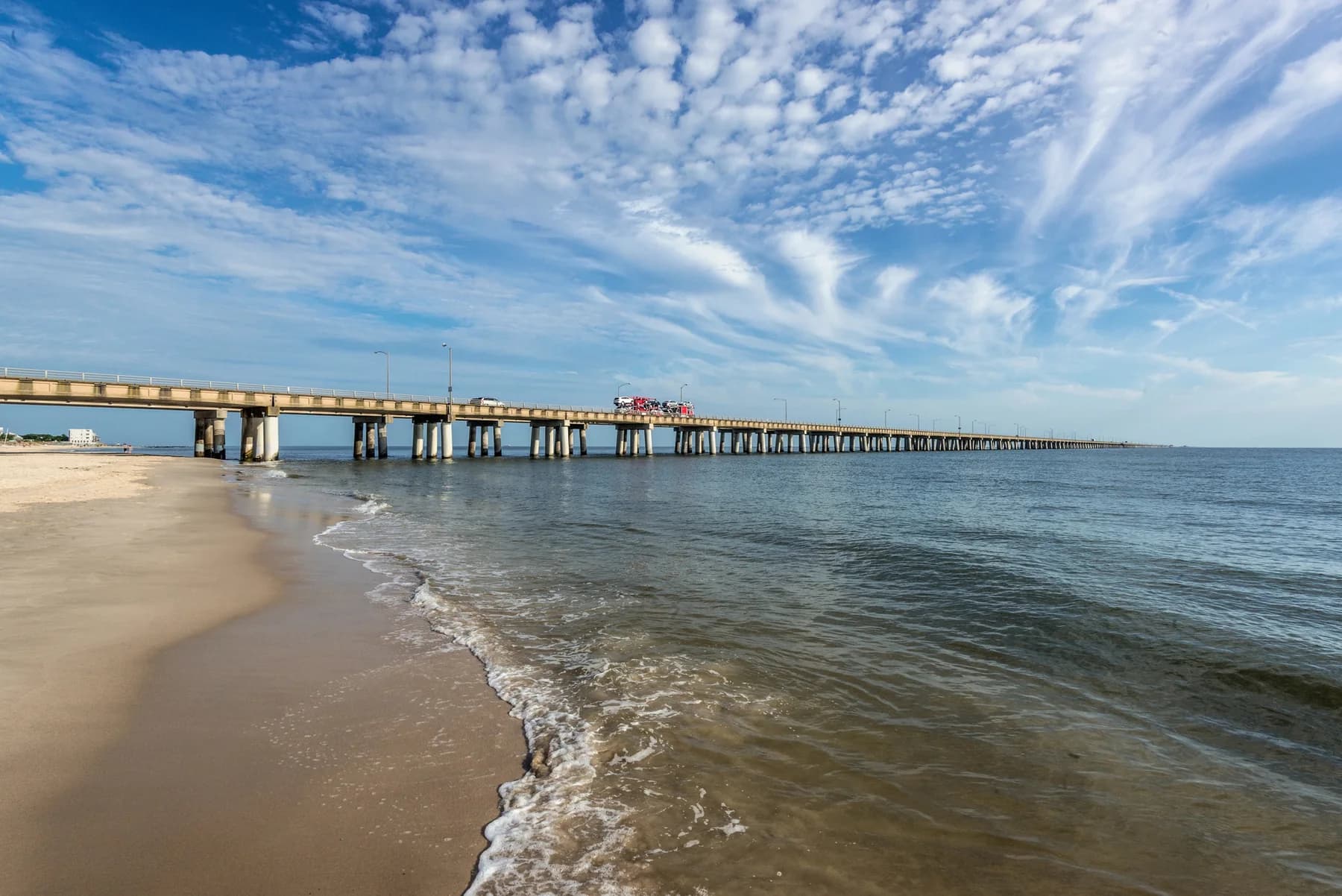
In 1964, engineers completed one of the most ambitious civil engineering projects in American history: a twenty-three-mile crossing that spans the entire mouth of the Chesapeake Bay, connecting Virginia's Eastern Shore to the Hampton Roads area. It's called the Chesapeake Bay Bridge-Tunnel, and driving across it is something you don't forget.
How It Works
The structure is exactly what the name says — a combination of bridges and tunnels. The approach from both shores is elevated bridge. Then, at two points where major shipping channels cross, the road dips into a tunnel beneath the Bay floor, allowing ocean-going vessels to pass freely overhead. You're driving on a bridge, and then suddenly you're under the water, and then you come back up. The engineering required to pull this off in the early 1960s was genuinely extraordinary.
The crossing takes about twenty-three minutes at the speed limit. There are four man-made islands at the tunnel portals, two of which have small fishing piers and a restaurant. People stop to fish, to photograph, or simply to stand on a dot of land in the middle of a massive bay and feel the scale of the water around them.
“When the weather is right and the bay is flat, it's one of the most beautiful drives anywhere in America. When it's blowing twenty-five from the northeast, it's something else entirely.”
The Crossing in Context
Before the Bridge-Tunnel opened, the only way from the Eastern Shore to Hampton Roads was a ferry, or a drive of several hours north around the top of the Bay. The structure effectively connected two regions that had been economically and socially isolated from each other despite being separated by only twenty-three miles of water.
Today the Bridge-Tunnel carries about four million vehicle crossings per year. It's the primary route between the Virginia Eastern Shore — Northampton and Accomack Counties, some of the most rural and historically rich land in the state — and the Norfolk metropolitan area. For the watermen and farmers of the Shore, it's simply the road to town.
Worth the Drive
If you've never driven the Bridge-Tunnel, add it to the list. Do it on a clear day if you can, in the early morning when the light is right. Stop at one of the fishing islands if they're open. Look back at the shore you came from and forward toward the shore you're headed to, and understand that twenty-three miles of open water used to be an all-day journey. What sits between those two shores is one of the more quietly impressive things America has ever built.